The Art of Storytelling
Published on Wheaton College’s Film and Digital Media Wordpress page on February 15, 2024
I’ve been thinking a great deal about why I’ve chosen this path for myself. Try though I might, I can’t seem to pinpoint exactly when I decided I wanted to make films, or even what inspired me to do so. As a kid, I liked movies, but I can’t say I was ever that fascinated by any of them. I mean, I watched Balto (1995) and Raiders of the Lost Ark (1981) more times than I can count, but I was never really all that obsessed with the art form in the way that many famous filmmakers describe their childhood. I think I have much more of an understanding and appreciation for the genre now, having seen a great many more movies than I thought I would ever watch and studying the craft over the past 8 years, but I have never had that much of a passion for the art of filmmaking itself. What drives me, and where I think my passion lies, is the art of storytelling.
Humans have told stories to each other since the dawn of time. Long before books and writing and drawing and art and film and music and movies, there were stories. Stories made to entertain each other, to make each other laugh and to explain why the sun disappeared at night and why the stars shone so bright. As time has gone on, storytelling has evolved and adapted into countless different mediums. Each painting tells a story, every song has a message, and every frame of every film is a painting. No matter what art we choose to create, we are telling a story, and that is precisely what I love about stories, true or otherwise. My father, who happens to be turning 70 this year, is the greatest storyteller I know. This is bolstered by the fact that he has lived a long, crazy life, but it’s more so the way he tells a story rather than what the story is about. His focus on the little details, and crazy twists and turns, and the captivating manner in which he speaks never fails to hook me, to draw me in and leave me speechless. I decided very early on that I wanted to be able to tell stories like he could.
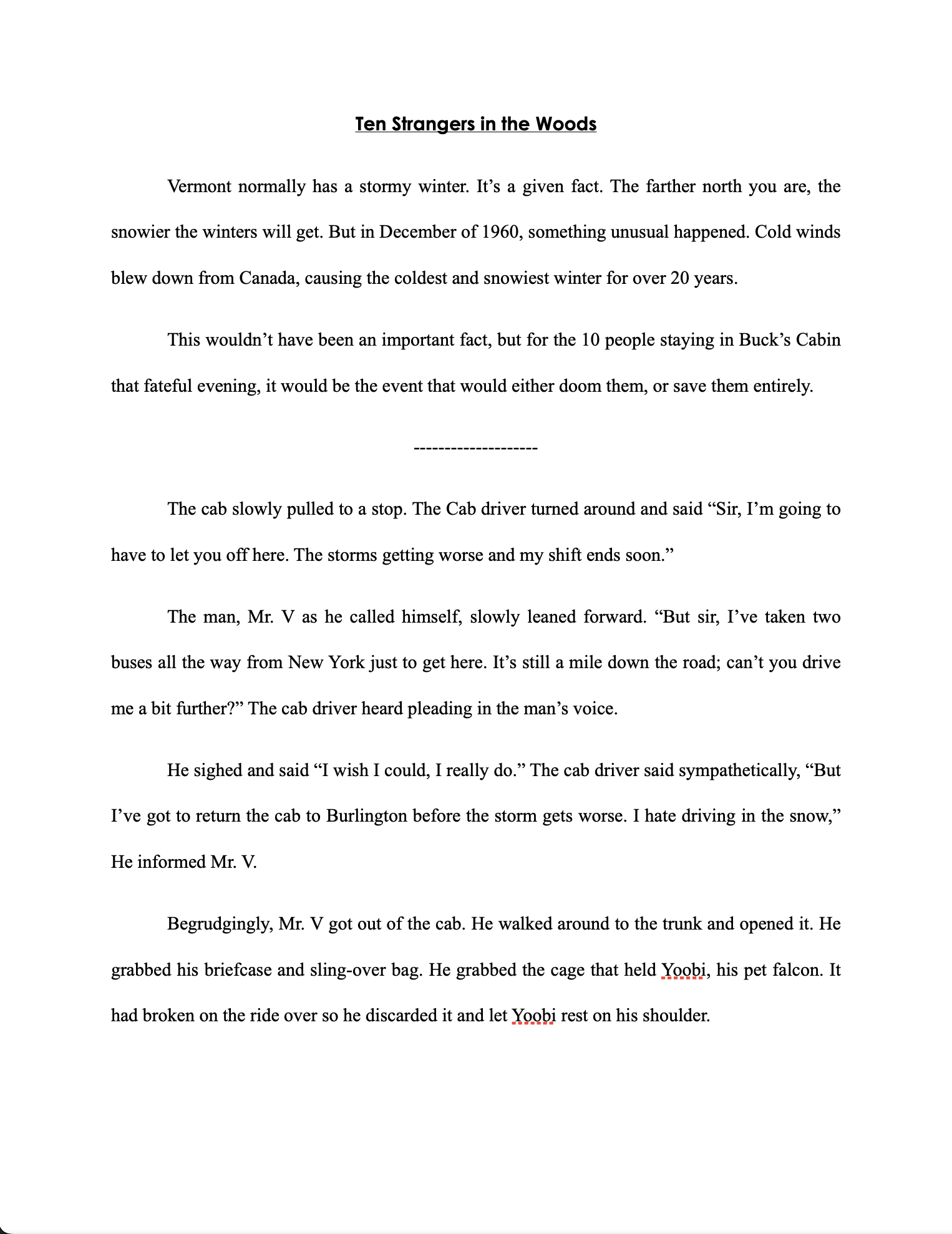
The more I became obsessed with being able to tell stories like my father, the more I began to write. Though I can’t remember why I got interested in making movies, I know that I have always loved to write. My closet is stuffed with old notebooks, dating back to 3rd grade, which are filled with stories I wrote about wolves and Native Americans and Doctor Who. In 8th grade, we were told to write a 3-4 page short story, and I wrote a 16 page Agatha Christie knock-off called “Ten Strangers in the Woods”, which saw the sinister Mr. V and his pet falcon Yoobi foiled their scheme to rob the residents of Buck’s Inn by a silver watch lying in the snow, a narrative device I established within the first two pages. The writing isn’t great, sure, but I loved writing it. I loved little details like that, clever clues laid out by storytellers early on in their story that come back towards the end and have drastic effects on the narrative. It was details like that that drew me to storytelling in the first place, and the stories my father told me were always jam-packed with these details. No matter how small or seemingly insignificant, they were always important to the story as a whole. If they didn’t come back to help or harm him at the end, they enriched the world of the story and made it feel as though I was actually there.
I don’t know how I want to tell my stories, but I know I want to tell them. It’s the thing that keeps me up at night, that forces me to get out of bed or pull my car over or pull my phone out at a concert because I’ve thought of a witty line of dialogue or a narrative device that’s too good not to write down. I want to tell stories. I feel as though I need to tell stories. Whether those stories come from my head and revolve around made-up people in made-up situations, or if they exist in the real world, told to me by strangers with a tale to tell or simply found in the wind in the trees, I know I want to tell them. A big part of being an artist is deciding why you make your art, and who you make your art for. I think I want to tell stories because I want people to hear them, but it’s also self-serving because that desire comes from within. I think I would still want to engage in this form of art, even if I was wholly unsuccessful at it. I feel just as passionate about telling stories to my friends and family as I do writing screenplays and filming shorts for the general public, and I don’t see either as less valuable than the other. Sure, my friends and family won’t pay me to tell them stories, but the passion is there just the same. But am I an artist if I only make art for my friends and family? Do I decide if my art is worth creating, or does the public get to decide that for me?
William Deresiewicz’s “The Death of the Artist” touches on this, and claims within its first 3 chapters that not everyone is an artist, even if they make art. The myth that gets told by big business and the tech companies killing the art industry is that they’re, in fact, making it easier than ever for people to make art. Anyone in the world can pick up a camera and film a short and post it, for free, on Youtube. You can use your phone and a guitar to create the next song of the summer, and post it for free on Spotify without anything even close to a record deal. They claim they’ve cut out the middleman and have placed the tools of creation right in the hands of the artists. This is good, in a sense, because anyone can create and their creations can be seen by everyone in the world, without the pesky hands of corporations getting in the way. The problem with this is, obviously, oversaturation. We, as consumers, will often choose comfort over challenge. If you arrive upon a song, or a movie, or a TikTok that doesn’t immediately satisfy or comfort you, you can scroll away, and there will be a hundred-billion-kajillion videos lying in wait, made by creators all wanting the same thing as each other: for their art to be seen. This is the way it’s always been, of course, but it’s easier than ever to disengage from art because of the sheer volume of it out there. Songs are reduced down to their best 15 seconds to play in the backgrounds of millions of Instagram reels, removing their context and, oftentimes, their power. Film clips are posted on Youtube shorts with more music played over them, in case someone gets bored by the dialogue, without even realizing that the only reason they would be bored is because they’re viewing something out of context. They’re being shown a snippet of an art piece, the bottom left corner of a painting, and being told it’s art. Or content. I fucking hate “content”, as it’s broadly defined. I think Deresiewicz would agree that the people cutting up other people’s art to make money off of it are doing not only that art a disservice, but art as a whole.
Our attention span is, broadly speaking, fucked. We don’t ever have to sit with something uncomfortable and, god forbid, think about why it makes us uncomfortable when we can just swipe away from it and forget it ever existed. Why would we ever listen to all of Patsy Cline’s “Crazy”, which is a gut-wrenching song about being in tragic, awful, unavoidable love, when we can hear her singing “Crazy” in the chorus played over a video of someone doing something stupid? When I was a child, I watched Terry Gilliam’s “Time Bandits” (1980), because it was one of my father’s favorite movies and I often had no choice over what we watched together. The movie is insane, featuring a group of time-traveling pirates being hunted by God for stealing his map of time who kidnap a child and try to fight the devil. It’s very 80s, in the best way possible, but none of that left as much of an impact on me as the ending. The film ends with Kevin, the aforementioned kidnapped child, waking up back at his house, with the film making it deliberately unclear whether everything we had just seen was a dream. He stumbles out of his burning house, disoriented and confused, only to watch his parents find a piece of pure evil in the microwave and instantaneously combust and die upon touching it. The firefighters leave, his parents disappear in a cloud of smoke and ash, and Kevin is left alone outside his burning home. The camera pans all the way out until we see the entire planet, and then credits roll. It’s an insane ending to an alleged kids movie, and I will never ever forget the way it made me feel when I saw it for the first time. I was a child, and it had never even occurred to me that a story could end that way, so dark and scary and unsatisfying and abrupt and I have yet to stop thinking about it. The fact that this swash-buckling, gallivanting story of pirates and minotaurs and medieval knights ends the way it does is one of the most important artistic experiences of my life. You never, ever see it coming, which is the whole point of it. To make you think, to make you confused and scared and to leave you in the uncomfortable silence of unanswered questions. The other day, I saw a Youtube short where someone had put generic cinematic music over a clip of the ending, and the caption simply read “Time Bandits scene 45”. Viewed on its own, the clip means nothing, and would never have left the impact on 7-year old John that the whole movie did, but this is the content being made today. And, looking around, it seems as though we’re never going back.
Oftentimes, a story is only worth telling if you hear the whole tale. If you put on Pink Floyd’s “Dark Side of the Moon” and skip to the very end of the album, it’s gonna sound nice, but it’s not going to have any weight behind it. You’re not going to understand all that has been done to lead to that moment. Odds are, It’s going to leave no impact on you. If you see the final scene of “When Harry When Sally” in a TikTok with boygenuis’ “We’re In Love” playing over it, you’re going to have precisely none of the context and it’s not at all going to resonate with you. I tear up everytime I get to the end of “When Harry When Sally” and Billy Crystal tells Meg Ryan he wants to spend the rest of his life with her, but watching the ending out of context made me feeling nothing. It’s like ignoring a joke and only listening to the punchline. A story is only worth telling, and only worth listening to, if you listen to the whole thing. I want to tell stories, but it’s becoming increasingly unclear whether or not people will listen to the stories I want to tell. But I still want to tell them. So, does that make me an artist? Or does the public’s reaction and perception of my art decide whether I’m an artist or not. Personally, I think being an artist is about desire. If you desire to create art, to tell stories, to sing your heart’s song, then you are an artist. I view my father as an artist simply because of his clear dedication and love of storytelling, and the profound impact it’s left on me all these years later. I would feel honored for my stories to touch someone the way my father’s stories told me, and I think that is the true essence of art and what being an artist is all about.